The life of Joseph Stalin: from revolutionary to absolute master
of reading - words
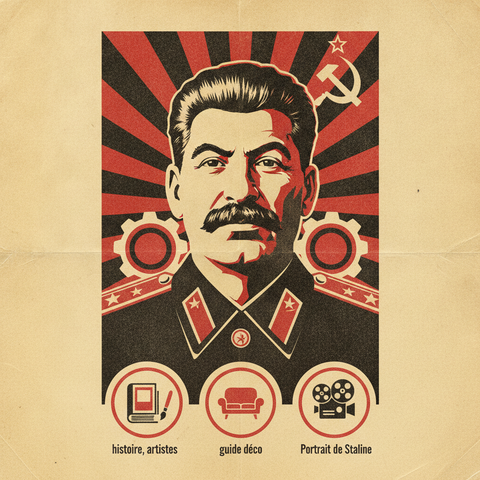
Joseph Stalin, an essential figure in 20th century, made history with his rise to the top of the Soviet Union and his controversial reign. Born Iosif Vissarionovich Dzhugashvili in Georgia, he became the unyielding dictator of a huge country, shaping theUSSR with an iron fist. This article delves into the biography of this enigmatic man, exploring his complex journey from the lands of Georgia to the head of an empire.
Stalin's early years in Georgia
Born in 1878 in the small town of Gori in Georgia, then part of the Russian Empire, the young Iosif Vissarionovich Dzhugashvili was destined for a future very different from the one he would experience later. Coming from a modest family, his childhood was marked by poverty and domestic violence. With an alcoholic father and a determined mother, Stalin developed an impressive resilience in the face of life's difficulties early on.
Stalin already showed, in his youth, a certain talent for academic intelligence, which led him to join the theological seminary in Tbilisi. However, attracted by Marxist ideas and revolted against authority, he quickly left his studies to engage in clandestine revolutionary activities. His political beliefs took root here, setting the stage for his future role on the world stage.
Revolutionary commitment
From the 1900s, Joseph Stalin became an active activist among the Bolsheviks. His involvement in various labor movements and his organizational talents allowed him to climb the ranks within the Communist Party. It was during this period that he adopted the pseudonym "Stalin", meaning "steel" in Russian, thus symbolizing his unwavering strength and determination, a military rigor which still inspires our communist jackets Soviet-looking. As part of this fervent commitment, some Soviet history buffs might be interested in objects like the Communist Napkin "Stalin and Victory".
Despite numerous arrests and exiles to the borders of the Russian Empire, Stalin never abandoned his commitment to the Bolshevik cause. His active participation in the russian revolution of 1917 strengthened his position within the movement. He was ready to seize every opportunity to further his political ambitions.
Rise to power: from secretary general to dictator
After the death of Lenin In 1924, a fierce struggle for power broke out within the Communist Party. Joseph Stalin, a skillful strategist, used his position as general secretary to place its allies in key positions. In a few years, he took almost absolute control of the state apparatus and the Party, gradually consolidating his authority.
Fidelity and loyalty were the watchwords of his reign. Stalin mercilessly eliminated all opposition, orchestrating purges unprecedented in the country's history. The 1930s were particularly bloody, seeing the arrest, deportation and execution of millions of people deemed undesirable or hostile to his regime.
Lenin's successor
As successor to Lenin, Stalin undertook a radical transformation of the Soviet economy. He launched a series of five-year plans intended to rapidly modernize the country through mass industrialization and forced collectivization of agriculture. Although these measures accelerated economic development, they also triggered catastrophic famines, leading to the deaths of millions of peasants.
His ultimate goal was to makeUSSR a global power capable of rivaling Western nations. Despite the immense suffering inflicted on the population, Stalin succeeded in propelling the Soviet Union onto the international stage as a major player. His authority remained uncontested throughout the country, making him the true absolute master of the USSR.
Stalin during World War II
There World War II represented a major test for Joseph Stalin. Initially surprised by the German attack of 1941 despite the non-aggression pact signed two years earlier, he eventually led the Soviet war effort, coordinating military strategies and mobilizing the resources necessary to repel the Nazi invader.
Under Stalin's leadership, the Red Army managed to turn the tide in decisive battles such as Stalingrad, a crucial turning point that turned the tide of the war in favor of the Allies. Final victory in 1945 cemented Stalin's stature as a beloved leader and national idol. However, the human and material consequences were tragic, forever upsetting Soviet society. To complete your collection, consider adding a revolutionary touch with an accessory like the Soviet red textured insulated mug.
Ruthless leadership
During the war, Stalin showed little compassion, applying strict methods to maintain discipline and restore order. Repression remained constant, even in times of conflict. Countless soldiers were executed for flight or suspected cowardice, underscoring the inflexibility of his governance.
After the war, tensions between Stalin and the other Allies increased, paving the way for the cold war. The ideological confrontation between the United States and the USSR gave rise to an ever-present climate of mutual distrust in the aftermath of the Allied victory. Stalin's expansionist ambitions spurred the global rivalry that would dominate the rest of the century.
Post-war and the Cold War
With the end of the World War II, Joseph Stalin concentrated its efforts on consolidating the Soviet empire. The influence of the USSR now extended across much of Eastern Europe, thanks to satellite communist regimes installed under its supervision. This made it possible to strengthen the Eastern bloc against the capitalist West.
This initial period of cold war is experiencing the rise of frenzied competition between superpowers. Western administrations perceived Stalin as a direct threat to their way of life, while he stoked suspicion and fear about the imperialist intentions of the United States. The nuclear arms race, carried out in parallel by the two camps, symbolized this growing distrust.
An iron policy
Always faithful to his authoritarian principles, Stalin tirelessly repressed all forms of dissent, both inside and outside theUSSR. This era remains famous for its staged public trials, where defendants underwent brutal interrogations before receiving their exemplary sentences.
Despite growing international condemnation, Stalin persisted in his rigid and isolationist approach. The criticism from the outside world mattered little to him; only the preservation of communism and the sustainability of its political heritage counted. Struck by paranoia, no potential betrayal could be tolerated.
Stalin's death and his legacy
On March 5, 1953, Stalin died in Moscow, leaving behind a country deeply marked by his decades of absolute rule. His funeral was grandiose, testifying to the cult of personality cultivated around him throughout his career. However, many of his contemporaries had lived in constant fear of this man whom they publicly idolized.
With the death of Stalin, the USSR entered a period of uncertain transition. The process of de-Stalinization initiated by Nikita Khrushchev, his successor, aimed to erase the footprints left by the tyrannical policies established by the despot. The systematic violence and purges gradually ceased, beginning a slow evolution towards greater civic freedom.
A complex heritage
The legacy of Joseph Stalin remains extremely ambiguous today. For some, he remains the symbol of the powerful leader who transformed Russia into a modern, enlarged and internationally respected nation. But for others, it is mainly its merciless cruelties and widespread oppression that capture the attention, evoking sadness and indignation.
Whatever our perception of the man who wore the legendary mustache with such presence, the profound impact of Stalin continues to fascinate historians and those curious about the tumultuous passage of the 20th century. His memory contrasts with that of other emblematic historical figures, raising questions and reflections on the complex ramifications of absolute power.