USSR propaganda: history, artists and symbols
of reading - words
There USSR propaganda designates all the political imagery produced by the Soviet Union between the October Revolution 1917 and the dissolution of the regime in 1991. At the heart of this device, the poster occupies a special place: it is one of the most studied visual supports of the 20th century, as much for its graphic power as for its political effectiveness. In a vast, ruralized and largely illiterate country following the revolution, it often replaced the newspaper and carried the word of the regime to the most remote villages.
Today, the Soviet propaganda is read through two complementary prisms: that of the historian and the student who seek to understand a political regime of the 20th century, and that of the graphic designer and decorator who recognize in these posters one of the founding matrices of modern design. This comprehensive guide retraces 70 years of Soviet iconography, presents the major artists (Rodchenko, Mayakovsky, Klutsis, Moor), deciphers the recurring symbols and explains the switch between the two great graphic schools of the time: the constructivism and the socialist realism.
The main thing to remember
- There USSR propaganda by poster starts from 1917 with the October Revolution and continues until the end of the Soviet Union in 1991.
- Two major trends follow one another: the constructivism (1917-1934, radical graphic avant-garde) then the socialist realism (1934-1991, figurative aesthetic imposed by Stalin).
- The major artists are Alexander Rodchenko, Vladimir Mayakovsky, Gustav Klutsis And Dmitri Moor.
- Recurring symbols: sickle and hammer, red five-pointed star, Herculean worker, kolkhoz peasant, soldier of the Red Army.
- Soviet imagery remains one of the most looted graphic references of the contemporary design (advertising, fashion, album covers).
What is USSR propaganda and why did it mark the 20th century?
USSR propaganda refers to all visual, textual, sound and cinematographic media produced by the Soviet regime between 1917 and 1991. to mobilize the masses, legitimize the single party and celebrate the economic and military achievements of the State. Cinema, radio, literature and theater contribute to it, but it isposter which established itself as the dominant support during the first three decades of the regime. The reason is demographic as much as political: in 1917, the literacy rate in the former Russian Empire did not exceed 24% in adults. The poster, an almost instantaneous visual support, becomes the only way to quickly reach a population spread across ten time zones.
The Bolshevik regime made visual propaganda a priority from the first months. Of the ROSTA windows (windows of the Russian Telegraph Agency) opened in Petrograd, Moscow and Odessa in 1919: hand-drawn posters, multiplied with stencils, were posted there, updated almost daily to comment on the military news of the civil war. The urban masses stop in front of these windows as we stop today in front of a news feed. When power commits to five-year plans from 1928, visual propaganda changes its function: it no longer mobilizes for war but for industrial, agricultural and cultural production. The poster becomes a mass educational tool, accompanying the literacy campaign which increases the literacy rate. 87% in 1939.
How was the Soviet poster born from the October Revolution?
The Soviet poster was born in 1919 in the urgency of the civil war, with the opening of ROSTA windows in Petrograd, Moscow and Odessa, visual propaganda workshops led by Vladimir Maiakovsky. The context of birth is that of a threatened State. After the Bolsheviks seized power in October 1917, Russia descended into a four-year civil war (1918-1921) which pits the nascent Red Army against the counter-revolutionary White Armies, foreign intervention troops and a multitude of peasant fronts. The territory is immense, communications cut, the printing press dislocated. Under these conditions, those in power invest massively in a light, mobile, reproducible medium: the plastered poster.
It was in this emergency that the ROSTA windows, hosted in Moscow by the poet Vladimir Mayakovsky and a designers’ workshop. The principle is simple: every day, on the basis of a military or political communiqué, the workshop produces a hand-drawn poster, multiplied with a stencil in a few dozen copies, plastered in the windows of the telegraph agency. The format has a lasting influence on the aesthetics of the Soviet poster: thick line, short slogan, immediate reading, restricted palette. Between 1918 and 1921, more than 3 million posters were produced and distributed throughout the former Russian Empire, an extraordinary volume for a country then in the middle of war and facing a paper shortage.
The founding poster of this period is undoubtedly “Have you joined the volunteer?” of Dmitri Moor (1920), which depicts a Red Army soldier pointing at the viewer against a red background surrounded by factory chimneys. The composition takes up the visual spring of Lord Kitchener's British recruitment poster (1914) by transposing it into a new chromatic grammar, dominated by revolutionary red.
Who are the great artists of Soviet propaganda?
Four figures dominate the history of the Soviet poster: Alexander Rodchenko, Vladimir Mayakovsky, Gustav Klutsis and Dmitri Moor. Each brings its own style and technique that will have a lasting impact on 20th century graphics.
- Alexander Rodchenko (1891-1956): painter, photographer and graphic designer, he is considered the father of Soviet political photomontage. His collaboration with Mayakovsky for state commercial posters (Mosselprom, 1923-1925) founded a radically new aesthetic: aggressive geometry, taut diagonals, palette red / black / white, bold sans-serif typography. His poster "Books" (1924) for Editions de l'Etat, which shows a young woman shouting the word "Lengiz" into a megaphone, is used to this day by contemporary graphic designers.
- Vladimir Mayakovsky (1893-1930): futurist poet, designer and slogan maker. Co-founder of ROSTA windows, he produced hundreds of poster slogans including the formula “To young communists, work!” remains emblematic. Mayakovsky brings a language to the Soviet poster: percussive rhythm, short sentences, mnemonic rhymes. He committed suicide in 1930, in a climate of increasing marginalization of the avant-garde.
- Gustav Klutsis (1895-1938): pioneer of political photomontage alongside Rodchenko, he develops monumental compositions which combine documentary photography and geometric typography. Its posters glorify the five-year plans and the figure of Stalin. Klutsis was arrested during the Great Terror in 1938 and executed the same year by the regime that he had nevertheless served with his art: a tragic paradox which sums up the destiny of an entire generation of avant-garde artists.
- Dmitri Moor (1883-1946): cartoonist and poster artist with more traditional training, anchor in the satirical press. He signed two major Civil War posters, “Have You Joined the Volunteer?” (1920) and “Help” (1921), the latter devoted to the Volga famine. His underlined feature, his figure of a skeletal worker raising his arms to the sky, has marked an entire iconography of humanitarian emergency.
What are the recurring symbols of Soviet imagery?
Seven symbols dominate Soviet iconography: the sickle and hammer, the five-pointed red star, the Herculean worker, the kolkhoz peasant woman, the Red Army soldier, the unfurled red flag and the wheat-gear couple. Soviet iconography is based on a restricted repertoire of signs which are repeated from one poster to another, to the point of forming a universally readable visual grammar. Here are the main symbols to know to decipher a vintage poster.
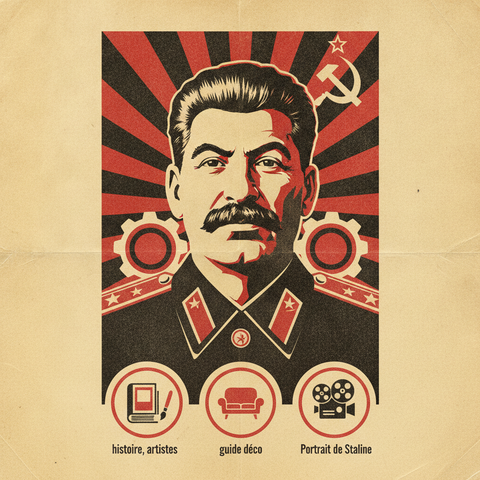
- The sickle and the hammer symbolize the union of the peasant class (sickle) and the working class (hammer). The pattern is officially adopted on the emblem of the USSR in 1923 and appears systematically on flags, badges, poster frontispieces and factory plaques.
- The five-pointed red star designates first the Red Army of 1918, then the Communist Party and the USSR itself. The five branches are sometimes read as the five continents that the revolution is supposed to affect.
- The Herculean Worker with bare arms represents the conscious proletariat. Often bare-chested or in overalls, he wields a hammer, anvil or shovel. This is the typical figure for five-year plan posters.
- The kolkhoz peasant with the red scarf embodies collectivized agricultural work. It appeared massively after 1929, alongside the forced collectivization of Soviet agriculture.
- The Red Army soldier in a long greatcoat and a red star chapka carries the values of defense of the Soviet homeland, particularly during the Great Patriotic War (1941-1945).
- The red flag unfurls serves as a dynamic background and sign of belonging; it adorns almost all monumental compositions.
- Wheat and gears symbolize the union of industry and agriculture, mirroring the sickle and hammer.
Checklist for deciphering an unknown Soviet poster:
- Locate the central symbol (hammer sickle, star, human figure) to identify the theme.
- Analyze the dominant palette: red / black / white oriented towards constructivism, natural polychromy oriented towards socialist realism.
- Date by typography: bold sans-serif and diagonals = before 1934; classic serif and strict alignment = after 1934.
- Locate the artist's signature (often at the bottom right, in Cyrillic).
- Translate it slogan at the top or bottom to confirm the period and political context.
Constructivism or socialist realism: what are the two main schools?
Constructivism (1917-1934) is a geometric and abstract avant-garde; socialist realism (1934-1991) succeeded it as a figurative and heroic state doctrine. The history of the Soviet poster is divided into two graphically opposed periods. The first, the constructivism, birth of avant-garde resulting from the artistic fermentation of the years 1910-1920. The second, the socialist realism, state doctrine imposed from 1934. The table below summarizes seven essential differentiation criteria.
| Criteria | Constructivism (1917-1934) | Socialist realism (1934-1991) |
|---|---|---|
| Dominant period | Lenin, NEP | Stalin, Khrushchev, Brezhnev |
| Graphic style | Geometric, abstract, photomontage | Figurative, academic, narrative |
| Palette | Red, black, white, ocher | Polychrome, natural colors |
| Typography | Sans-serif, bold, diagonal | Serif, ordered, classic |
| Human figure | Stylized silhouette | Idealized, heroic, anatomical |
| Key artists | Rodchenko, Mayakovsky, Klutsis, El Lissitzky | Deineka, Toidze, Koretski |
| Official status | Avant-garde tolerated then fought | Official state doctrine |
The changeover of 1934 is a doctrinal event. THE First Congress of Soviet Writers, meeting in Moscow in August 1934, imposed socialist realism as unique artistic doctrine of the USSR. The principle is summarized by Andrei Zhdanov, Party ideologist: art must be "national in form, socialist in content" and represent reality "in its revolutionary development". Concretely, constructivist artists are marginalized or suppressed. Rodchenko falls back on photographic reporting for regime magazines. El Lissitzky died in 1941 after having produced his last works in the service of the war. Klutsis, as we have seen, paid with his life in 1938. The following generation, trained at the Fine Arts of Leningrad and Moscow, painted heroic frescoes of workers, soldiers and miners in theatrical poses, closer to the academies of the 19th century than to the futuristic collages of the 1920s.
Why does Soviet aesthetics still inspire contemporary design?
The constructivist aesthetic remains one of the most cited references in contemporary design because it has forged a universal visual grammar: tense diagonals, bold sans-serif and a red/black/white palette. Far from having disappeared with the USSR, it continues to irrigate world communication 35 years after the end of the regime. The phenomenon goes far beyond nostalgia: it is a formal matrix (diagonals, bold sans-serif, red/black/white palette, photomontage) which imposes itself whenever necessary. hit fast and hard an urban public saturated with signs.
Some emblematic reappearances:
- Album covers: the cover "You Could Have It So Much Better" by Franz Ferdinand (2005) is an explicit quote from Rodchenko; The Clash, Public Enemy and more recently IDLES have used the same visual repertoire.
- Fashion: the 2015-2020 decade saw the explosion of the Gosha Rubchinskiy, Vetements and Yeezy collections, which openly replayed the codes of post-Soviet sportswear and constructivist graphics.
- Advertising and institutions: Apple's 1997 "Think Different" campaign, signed TBWA Chiat Day, is openly credited as an heir to Soviet compositions by its own designers.
- Contemporary political posters: Shepard Fairey's "Hope" poster for the Obama 2008 campaign uses the codes of the constructivist poster (restricted palette, stylized figure, bold sans-serif typography).
- Design schools: Penninghen, Estienne, ECAL and most major European schools still study Rodtchenko, Klutsis and El Lissitzky as founding references of modern graphic design.
The Slate.fr article "The Soviet aesthetic is everywhere in our pop culture" (2024) devotes this permanence: 35 years after the end of the USSR, the visual language forged in the ROSTA workshops continues to irrigate global communication.
How to integrate USSR propaganda into your decoration at Communist Universe
Six families of Communist Universe products allow you to play up Soviet imagery at home: framed posters, flags, metal plaques, stickers, bed sets and textiles, t-shirts and accessories. Inviting Soviet iconography into your home is inviting one of the most powerful graphic languages of the 20th century. Several media allow us to play this visual heritage without falling into overload. Here is the selection of collections Communist Universe most suitable for a retro-graphic decoration of living room, office, workshop or kitchen.
- Communist posters framed or not (communist-poster): reproductions inspired by classic compositions of the period, A2 or A3 format, natural wood or black aluminum frame. A poster above a sofa or a desk is enough to create a strong graphic atmosphere.
- USSR flags and banners (communist-flag): the hammer and sickle flag hanging at the back of the wall reproduces the monumental presence of the 1930s. Particularly suitable for workshops, theme bars and teenagers' rooms with an assumed bias.
- Communist metal plaques (communist-metal-plate): enameled and printed visuals on canvas, perfect for retro kitchens, family bars or entrance hallways. The vintage rendering is reminiscent of industrial signs from the 1950s.
- Stickers and stickers (communist-stickers): medium or large format, to place on laptop, headphones, cabin suitcase, fridge or mosaic wall. For a touch of Soviet iconography without structural commitment.
- Bedding set and cushion covers (communist-bed-set And communist-cushion-cover): hammer sickle, red star, kolkhoz worker motifs. For a total bedroom look or for a few sofa cushions that play off the strong pattern.
- CCCP t-shirts and accessories (t-shirt-cccp And communist-accessory): to carry Soviet imagery rather than hang it. From the CCCP logo t-shirt to the metal flask, including the sickle hammer pins.
Composition key: alternate a large visual object (framed poster or wall flag) with two or three pieces of smaller format (cushion, metal plate, stickers) to avoid saturation. The red/black/white palette goes naturally with light wood furniture, raw parquet flooring or ash gray walls.
FAQ - Frequently asked questions about USSR propaganda
Here are the six most asked questions about USSR propaganda, from iconic posters to major artists to the meaning of the hammer and sickle.
What are the most famous Soviet propaganda posters?
Five emblematic posters recur in all the anthologies: “Have you joined the volunteer?” of Dmitri Moor (1920), "Books" ofAlexander Rodchenko (1924) with his young wife megaphone, “The motherland is calling!” by Irakli Toidze (1941, central poster of the Great Patriotic War), "Help" by Moor (1921, Volga famine) and the posters glorifying the signed five-year plans Gustav Klutsis in the 1930s.
Who are the artists of Soviet propaganda?
Four figures dominate the history of the Soviet poster: Alexander Rodchenko, father of political photomontage; Vladimir Mayakovsky, poet-sloganist of ROSTA windows; Gustav Klutsis, master of monumental compositions and executed in 1938 during the purges; Dmitri Moor, Civil War cartoonist. Alongside them, we also cite El Lissitzky, Alexandre Deineka and Irakli Toidze for the period of socialist realism.
What do the sickle and hammer represent?
There sickle and hammer symbolize the union of the peasant class (sickle) and the working class (hammer), the ideological basis of the Bolshevik regime. The pattern is made official on the emblem of the USSR in 1923 and appears systematically on flags, badges, frontispieces of posters, coins and facades of official buildings. It is one of the most identifiable political signs of the 20th century.
How to recognize a USSR propaganda poster?
Several indices coexist: one dominant palette red / black / white for the constructivist period, or softer polychrome for socialist realism; a diagonal bold sans-serif typography (before 1934) or strictly aligned classic serif (after 1934); A short slogan in Cyrillic; the presence of signature symbols (hammer sickle, red star, Herculean worker); and generally an artist signature at the bottom right.
What is the difference between constructivism and socialist realism?
THE constructivism (1917-1934) is a geometric and abstract avant-garde, dominated by photomontage and the red/black/white palette, worn by Rodchenko, Maiakovski and Klutsis. THE socialist realism, a state doctrine imposed in 1934 by the First Congress of Soviet Writers, succeeded it: figurative, academic and heroic style, polychrome palette, idealized human figures. The comparison table above details seven differentiation criteria.
Where to buy a USSR propaganda poster in France?
Several solutions coexist: flea markets (Saint-Ouen, Vanves) for sometimes expensive period originals, specialized galleries (Soviet in Paris) for high-end framed posters, and online stores for quality reproductions at an affordable price. The collection communist-poster by Communist Universe offers a selection of reproductions inspired by classic compositions, in framed or unframed formats, designed for retro-graphic interior decoration.