Creation of the USSR 1922: chronology, actors and heritage
of reading - words
On December 30, 1922, in the Bolshoi Theater in Moscow, the First Congress of Soviets of the USSR adopted the Declaration and the Treaty which founded the Union of Soviet Socialist Republics. Four republics signed that day: Soviet Russia, Soviet Ukraine, Soviet Belarus and Soviet Transcaucasia (which then brought together Georgia, Armenia and Azerbaijan). The creation of the USSR thus puts an end to five years of revolution and civil war, and opens a period of 69 years which will not end until December 26, 1991. This article retraces the entire chronology of the creation of the USSR, from the Bolshevik uprising of 1917 to the Soviet Constitution of 1924, explaining the political context, the key actors and the iconographic heritage left by this period founder.
The essential things to remember
- Official date: December 30, 1922, during the First Congress of Soviets of the USSR in Moscow.
- Acronym: USSR (Union of Soviet Socialist Republics) or CCCP in Cyrillic.
- Founding republics: RSFSR (Russia), Ukrainian SSR, Byelorussian SSR, Transcaucasian RSFS.
- Architects: Lenin (federal vision) and Stalin (then Commissioner for Nationalities).
- Capital: Moscow, since the transfer from Petrograd in March 1918.
- Lifespan: 69 years, from 1922 to the official dissolution of December 26, 1991.
- Founding Constitution: adopted on January 31, 1924, a few days after Lenin's death.
What is the creation of the USSR and why does December 30, 1922 mark history?
The creation of the USSR refers to the legal act of December 30, 1922 which transformed four distinct Soviet republics into a single federation. This event is the culmination of five years of upheaval: the fall of Tsarism in February 1917, the Bolshevik takeover in October 1917, the Russian Civil War from 1918 to 1921 and the first attempts to integrate neighboring republics in 1920-1922.
On December 30, 1922, in the large hall of the Bolshoi Theater in Moscow, 2,215 delegates representing approximately 100 million inhabitants ratified two founding texts. The Declaration on the Formation of the USSR sets out the political principles of the union. The Treaty on the Formation of the USSR establishes the distribution of powers between the federation and the member republics. These two documents constitute the institutional birth certificate of the Soviet state.
The historical challenge of the creation of the USSR is threefold. On the political level, it stabilizes the territorial mosaic inherited from the old Russian Empire by giving it a modern federal form. On the ideological level, it affirms the ambition of a world socialist organization in preparation. On a symbolic level, it established a new flag, new coats of arms and a new state model which would inspire more than fifteen other regimes during the 20th century. The creation of the USSR therefore inaugurated a 69-year political experience which would have a lasting impact on the century.
How did the October Revolution of 1917 pave the way for the USSR?
The October Revolution of 1917 is the founding event without which the creation of the USSR would not have taken place five years later. It all began in February 1917 (Julian calendar, March according to the Gregorian calendar) with the fall of Tsar Nicholas II and the establishment of a provisional government led by the liberals then by Alexander Kerensky. This intermediate regime did not succeed in getting Russia out of the First World War or resolving the agrarian question.
On the night of October 25, 1917 (Gregorian November 7), the Bolshevik Red Guards took the Winter Palace in Petrograd, then the imperial capital. Lenin delivers the famous formula before the Second All-Russian Congress of Soviets announcing that "the power of the Soviets" has been established. Trotsky chairs the Revolutionary Military Committee which coordinates the insurrection.
Three immediate decisions structure the first months:
- Peace Decree of October 26, 1917: call for peace without annexation or compensation.
- Decree on land of the same day: nationalization of large land properties.
- Decree on workers' control of November 1917: handing over of factories to workers' committees.
In January 1918, the Third Congress of Soviets officially proclaimed the Russian Soviet Federative Socialist Republic (RSFSR), the first institutional building block of the future creation of the USSR. The capital was transferred from Petrograd to Moscow in March 1918, for fear of a German advance. In July 1918, the Constitution of the RSFSR was adopted: it is the matrixlegal which will serve as a model for the other Soviet republics before their reunion in 1922.
What happened during the Russian Civil War from 1918 to 1921?
The Russian Civil War from 1918 to 1921 pitted the Bolshevik Red Army against the counter-revolutionary White Armies and directly conditioned the creation of the USSR that would follow. The conflict broke out in the spring of 1918, when the former Tsarist generals, Cossack forces and foreign armies (French, British, American, Japanese and Polish) intervened to overthrow power. Bolshevik.
Three major fronts open simultaneously. In the south, the Volunteer Army of Denikin and then Wrangel led the main white offensive from the Don and the Crimea. In the east, Admiral Kolchak proclaimed an all-Russian government in Omsk and advanced towards the Volga. In the northwest, General Yudenitch advances towards Petrograd with British help. Leon Trotsky, appointed People's Commissar for War in March 1918, created and organized the Red Army, which reached 5 million soldiers at the peak of the effort in 1920.
The most dramatic episode of this period was the execution of the imperial family on the night of July 16 to 17, 1918 in Yekaterinburg, followed by mutual terror between the two camps. The famine of 1921, which mainly hit the Volga region, added to military losses and typhus epidemics.
The total demographic toll of the civil war exceeds 10 million deaths between battles, epidemics and famines over the years 1918-1922, according to demographic estimates published by INED and the journal Population Studies. This figure even exceeds that of Russian soldiers who died during the First World War and constitutes a founding demographic trauma of the Soviet era.
In the spring of 1921, the Bolsheviks defeated almost all of the White armies. The institutional unification of the victorious Soviet republics then became possible and politically necessary. The creation of the USSR in 1922 is, in this sense, the direct consequence of the victory of the Red Army in this war.
What are the four founding republics of the USSR?
Four Soviet republics signed the Treaty of December 30, 1922 and constituted the founders of the USSR. Each had its own political and ethnic history before the union. The table below summarizes the characteristics of these four entities at the time of the creation of the USSR:
| Republic | Official name | Capital | Integration date |
|---|---|---|---|
| Soviet Russia | Russian Soviet Federative Socialist Republic (RSFSR) | Moscow | December 30, 1922 |
| Soviet Ukraine | Ukrainian Soviet Socialist Republic (Ukrainian SSR) | Kharkov then kyiv | December 30, 1922 |
| Soviet Belarus | Byelorussian Soviet Socialist Republic (Byelorussian SSR) | Minsk | December 30, 1922 |
| Soviet Transcaucasia | Transcaucasian Soviet Federative Socialist Republic (Transcaucasian SFSR) | Tbilisi | December 30, 1922 |
The RSFSR is by far the largest and most populated. It extends from the Finnish border to the Pacific and includes approximately two thirds of the total population of the future USSR. The Ukrainian SSR brings the rich agricultural lands of the south and the industrial basin of Donbass. The much smaller Byelorussian SSR occupies a strategic position between Russia and Poland. The Transcaucasian SFSR, formed in 1922 by the merger of Georgia, Armenia and Azerbaijan, will be dissolved in 1936 during the new Soviet Constitution: its three components will then become distinct federated republics.
At the exact time of the creation of the USSR, the total population of the four founding republics was close to 100 million inhabitants, or approximately 60% of the population of the former Russian Empire in 1914. The USSR will gradually expand by eleven new republics between 1924 and 1956, to reach the 15 federated republics that the rest of its story.
Why did Lenin and Stalin oppose each other over the creation of the USSR?
The exact project for the creation of the USSR divided Lenin and Stalin during the summer and autumn of 1922, around the question of nationalities. The debate concerns the way of integrating the neighboring republics: should the RSFSR absorb them as autonomous entities within itself, or should it enter with them, on an equal footing, into a new federation?
Stalin, then People's Commissar for Nationalities since 1917, defended the so-called autonomization project. According to him, Ukraine, Belarus and Transcaucasia must join the RSFSR as autonomous republics, without a separate federal personality. This option simplifies the institutional architecture and reinforces the central power of Moscow.
Lenin, seriously ill since his first stroke in May 1922, refuses autonomy. He proposes an egalitarian federal union in which the RSFSR enters as a partner of the same rank as the other republics, in a new entity called the USSR. This vision will theoretically open up a right of secession to republics, a principle enshrined in the 1924 Constitution but never applied in practice.
The conflict escalated in September 1922 around the Georgian affair: Stalin and Ordzhonikidze used force against the Georgian communists in favor of a more flexible union. Lenin was indignant in his private correspondence and criticized the "brutal Russification" implemented by Stalin. On December 30, 1922, the same day as the founding Congress, he dictated a memorandum entitled "On the question of nationalities or on autonomization" in which he denounced what he called Stalin's "Great Russian chauvinism".
Lenin was absent from the First Congress of Soviets of the USSR on December 30, 1922. Nailed home by three successive strokes in May, December 1922 and March 1923, he would never be able to physically see the USSR that he conceptually founded. He died on January 21, 1924, just 25 days before the adoption of the Soviet Constitution of 1924, without having been able to reorient the political course taken by Stalin. It is a tragic paradox of the creation of the USSR: its main intellectual architect did not attend his birth certificate, and his successor designated by him in the “Testament of Lenin” was not able to take power.
How did the Soviet Constitution of 1924 institutionalize the USSR?
The Soviet Constitution of January 31, 1924 transformed the creation of the USSR into a stable and lasting legal architecture. Adopted by the Second Congress of Soviets of the USSR, ten days after the death of Lenin, it consolidated the principles of the Treaty of 1922 and established the institutional organization of the Soviet federal state for the decades to come.
Three major institutions structure central power:
- The Congress of Soviets of the USSR: supreme assembly, meeting every two years in full.
- The Central Executive Committee (TsIK): permanent body between sessions of the Congress, divided into two chambers (Union Council and Council of Nationalities).
- The Council of People's Commissars (Sovnarkom): federal executive government, equivalent to a council of ministers.
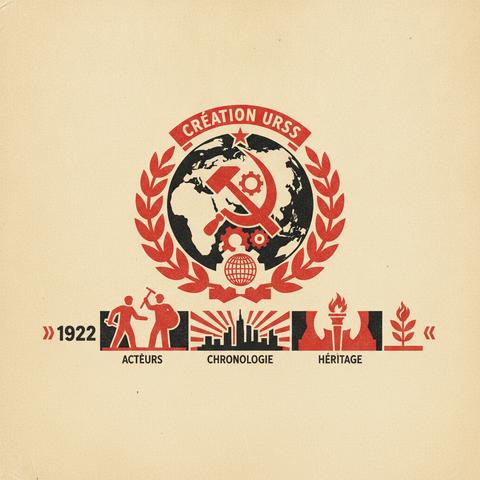
The Constitution of 1924 also established the official symbols of the federation. The flag, adopted in 1923, is red with a crossed hammer and sickle surmounted by a five-pointed star in the upper left corner. The coat of arms represents a terrestrial globe framed by ears of wheat linked by a red ribbon bearing the inscription "Proletarians of all countries, unite" in the languages of the founding republics. The official anthem remained The International until 1944, when Stalin replaced it with a specific anthem of the USSR composed by Alexander Alexandrov.
The 1924 Constitution also includes a theoretical right of secession for each federated republic, a principle inherent in Lenin's vision of union. This right would never be implemented until the 1990s, when the Baltic States invoked it to leave the USSR. The 1924 text was revised for the first time in 1936 (the so-called Stalinist Constitution, which took the USSR from 7 to 11 federated republics), then a second time in 1977 (the so-called Brezhnev Constitution). These two revisions modify the administrative organization without calling into question the original Soviet creation of 1922.
How to decorate your interior with the iconography of the creation of the USSR at Communist Universe?
The iconography born from the creation of the USSR in 1922-1924 remains one of the most powerful graphic aesthetics of the 20th century, and Communist Universe offers a complete catalog to put it back on stage ins a contemporary interior. Whether you are a decorator, collector, history student or simply passionate about Soviet visual heritage, here are the key pieces that echo the founding period 1917-1924.
The 1920s propaganda posters are the central piece to be favored. The communist-poster collection brings together reproductions based on the codes of Russian constructivism (Rodchenko, Klutsis) which dominated the decade of the creation of the USSR. A2 or A3 format, dark wood or brushed aluminum frame, these posters feature the historic vermilion red, black and off-white palette.
The red flag with sickle and hammer, adopted in 1923 and institutionalized by the Constitution of 1924, is a piece of visual authority. The communist-flag collection offers banners faithful to the historic pavilion, perfect as a wall background in a creative workshop, a collector's office or a retro-themed bar.
For a more discreet approach, the communist metal plaques from the communist-metal-plaque collection take up the aesthetic of enameled industrial plaques from the Soviet era. Medium size, aged finish, they find their place in a retro kitchen, a reading corner or an entrance.
The CCCP acronym (URSS in Cyrillic) is one of the most recognizable visual markers inherited from the creation of the USSR. The t-shirt-cccp collection offers models to wear every day for lovers of Soviet history. The communist-cap collection features headgear inspired by Soviet civilian models from the 1920s.
To complete a selection already made, the communist-accessory collection brings together pins, mugs, stickers and small decorative objects with Soviet motifs. Jewelry lovers can turn to the bijoux-communiste-1 collection, which offers hammer sickle pendants, red star and other symbols directly inherited from the iconography established in 1922-1924.
Check-list for creating a decoration historically faithful to the creation of the USSR:
- Choose a pivotal piece: a large framed poster (60x80 cm minimum) or a 90x150 cm wall flag.
- Keep the historical palette: dominant vermilion red, black and white accents, no more than two secondary colors (ocher, industrial gray).
- Limit the acronyms to one per piece: hammer sickle OR red star OR CCCP acronym, never all three together on the same object.
- Check chronological coherence: for a “founding 1920s” atmosphere, favor constructivist visuals rather than those of socialist realism after 1934.
- Keep a modest scale: 3 to 5 major pieces are enough in a 20 m2 room, beyond that the museum effect becomes kitsch.
FAQ - Frequently asked questions about the creation of the USSR
This FAQ brings together the six most asked questions about the creation of the USSR, with direct and historically documented answers.
When exactly was the USSR created?
The USSR was officially established on December 30, 1922. On that day, the First Congress of Soviets of the USSR met in the Great Hall of the Bolshoi Theater in Moscow and ratified the Declaration and Treaty on the formation of the Union of Soviet Socialist Republics. The date is recorded as the institutional birth certificate of the Soviet state, which will last 69 years until December 26, 1991.
What are the four founding republics of the USSR?
The four founding republics are the RSFSR (Russia), the Ukrainian SSR, the Byelorussian SSR and the Transcaucasian SFSR. The latter would then federate Georgia, Armenia and Azerbaijan, which would become distinct republics in 1936. The USSR would gradually expand by eleven new republics between 1924 and 1956, then totaling 15 federated republics until its dissolution.
Who founded the USSR, Lenin or Stalin?
Both, in a conflicting dynamic. Lenin is the intellectual architect of the egalitarian federation, which he defends from Moscow despite his illness. Stalin, then Commissar for Nationalities, was the operational executor but initially defended a project of autonomy which Lenin refused. The creation of the USSR on December 30, 1922 is a compromise between these two visions, closer in form to that of Lenin.
Why did Lenin oppose Stalin on the creation of the USSR?
Lenin criticized Stalin for his autonomization project which would have absorbed the republics into the RSFSR rather than constituting an equal union. The conflict culminated in September 1922 during the Georgian affair, where Stalin used force against the Georgian communists in favor of a more flexible union. Lenin denounced what he called Stalin's Great Russian chauvinism in several memoirs written between December 1922 and March 1923.
What do the acronyms URSS and CCCP mean?
USSR means Union of Soviet Socialist Republics, and CCCP is the same acronym written in Cyrillic (Soyuz Sovetskikh Sotsialisticheskikh Respublik). Both versions designate exactly the same state. The CCCP acronym became one of the most recognizable visual markers of Soviet iconography, omnipresent on the flags, coats of arms, uniforms and official objects of the federation between 1922 and 1991.
When was the USSR dissolved?
The USSR was officially dissolved on December 26, 1991. On that day, the Supreme Soviet adopted Declaration No. 142-N which recognized the disappearance of the Union of Soviet Socialist Republics as an entity under international law. The day before, Mikhail Gorbachev had resigned from his post as president of the USSR. The federation thus lived 69 years between its creation of the USSR on December 30, 1922 and its dissolution on December 26, 1991.