Russian dances: kazatchok, khorovod, Kalinka and more
of reading - words
A Cossack jumps in place, legs bent, arms crossed, while an accordion picks up the tempo and a circle of young women in red sarafans swirl around him. Behind this cliché hides an immense universe: Russian dances cannot be reduced to kazatchok or the Bolshoi ballet. They form a living heritage woven from Slavic folklore, Cossack traditions, ethnic dances from the Caucasus and Siberia, and a classical school which gave the world Rudolf Nureyev and Maya Plisetskaia. This article offers a cultural panorama of traditional Russian dances, from the pagan khorovod to the kazatchok jumps, including Kalinka, Troika, Yablochko, the Caucasian lezguinka and the imperial ballet, with a practical guide for recreating the visual and musical.
The essential things to remember
- More than 190 recognized peoples in Russia explain the spectacular diversity of traditional dances, from Slavic khorovod to Caucasian lezginka.
- Khorovod and kazatchok are the two best-known Russian dances, one danced in a round, the other in squatting jumps called prisiadka.
- Kalinka is not a dance but a song composed in 1860 by Ivan Larionov, which became the basis for popular choreographies.
- Rudolf Nureyev, the most famous Russian dancer, was born on March 17 1938 on a train crossing Siberia.
- The classic ballets of the Bolshoi and the Mariinsky, trained at the Vaganova Academy, have made the Russian school shine on stages around the world.
A panorama of Russian dances: from folklore to classical ballet
Russia has more than 190 officially recognized peoples, which explains why Russian dances form a dense cultural mosaic rather than a homogeneous block. Most European countries claim one or two national dances. Russia has several dozen, over an area stretching from the Baltic to the Pacific. It is this diversity which makes the richness of a panorama of Russian dances.
To find your way around, we distinguish three main families:
- Popular Slavic folklore: khorovod (round), kazatchok (Cossack jump), Kalinka, Troika, barynia. Village and holiday dances, transmitted orally, which have survived thanks to state ensembles like Beriozka or Igor Moiseyev.
- Dances of non-Slavic peoples: lezguinka of the Caucasus, sabantoui of the Tatars, iokhor of the Buryats, mime dances of the Chukchi of the far North, ouerk kiafe of the Kabardians and Balkars.
- Russian classical ballet: imperial school founded in the 18th century, formalized by the Vaganova Academy in Saint Petersburg, embodied by the Bolshoi in Moscow and the Mariinsky in Saint Petersburg.
These three families have not evolved in silos. At the beginning of the 20th century, Serge de Diaghilev's Ballets Russes popularized in Paris a mix between folklore and avant-garde. The Soviet era then institutionalized state ensembles, whose stylized choreographies established in the Western imagination the best-known version of Russian dances. To immerse themselves in this universe, many start by collecting Soviet posters.
The most famous Russian dance: khorovod (round)
Khorovod is the oldest and most emblematic of Russian dances, and the one that best answers the question “what is the most famous Russian dance?”. It is a round dance, danced in a circle hand in hand, at a slow to moderate tempo, with characteristic chased steps. The circle is formed around a central point (tree, fire, musician), and its direction of rotation follows the path of the sun.
A pagan ritual that has become a village festival
Before being a dance for entertainment, the khorovod was a pagan ritual dedicated to Yarilo, the Slavic god of the spring sun. Ethnographers document these circular Russian dances from the early Middle Ages, as a tool for social cohesion. The round marked the major moments of the agricultural calendar: spring equinox, end of harvest, parish festivals after Christianization.
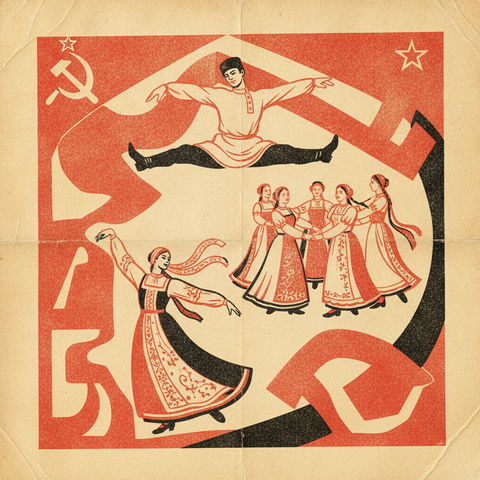
What is striking about khorovod is the collective and feminine dimension. The participants are young women dressed in sarafan (traditional apron dress), wearing kokochnik (embroidered half-moon headdress decorated with pearls), sometimes equipped with a red scarf which they twirl. The men join the circle or break away to perform more virtuoso figures.
The Russian khorovod shares strong roots with the Ukrainian round, which answers the question "what is the Ukrainian folk dance?". The two countries claim this common Slavic heritage, with regional variations: not faster in Ukraine, different embroidered costumes.
The kazatchok and the crouching jumps of the Cossacks
The kazatchok is the famous Russian crouching dance, the one where men jump with their legs bent, arms crossed, at an increasing tempo. We see it in war films, banquets, folkloric performances. Kazatchok (sometimes spelled kozatchok) is a traditional dance of Ukrainian origin, historically practiced by the Cossacks, and spread throughout Russia from the 18th century.
The rhythm is fast, in 2/4 binary measure, and the dance is built around a star figure: the prisiadka, this squatting jump which requires an enormous relaxation of the thighs. The dancer descends into a crouched position, extends one leg forward, alternates, and jumps back up. The more the tempo accelerates, the more acrobatic the prisiadka becomes, until the spectacular fall which closes the sequence.
The Cossacks of Don and Zaporizhia developed these Russian dances as a demonstration of virility in their military encampments. The prisiadka served as a warm-up, training and challenge between riders. With Sovietization, the kazatchok entered the repertoire of state ensembles, which popularized it on stages around the world, making the Cossack the visual icon of Russian dances in the Western imagination.
What is the difference between Russian dance and Ukrainian dance? Both share common Cossack Slavic roots but evolved distinctly after the 19th century. Ukrainian dances (hopak in particular) favor higher jumps and floral embroidery. Russian versions of kazatchok emphasize speed and collective figures in a line. Lovers of Cossack aesthetics will find these motifs in the retro CCCP t-shirts inspired by Slavic military culture.
Kalinka, Troika and Yablochko: popular Russian dances that have become iconic
Kalinka, Troika and Yablochko are the three popular Russian dances best known internationally, even if their true origin is often unknown: Kalinka is a song from 1860, Troika imitates a three-horse team, and Yablochko was born in the Soviet navy.
Kalinka: a song from 1860, not a thousand-year-old dance
Big surprise: Kalinka is not an ancestral dance, it is a song composed in 1860 by the Russian musician Ivan Larionov. The piece, written in Saratov, tells the story of the ripening of a Slavic red berry, kalina (viburnum). The song became a standard of popular Russian dances, performed by the choirs of the Red Army and the Alexandrov ensemble. To its increasing tempo melody, the dancers develop couple choreographies punctuated with taps and prisiadkas, with a spectacular final acceleration. The song is not 170 years old: proof of the strength of Russian dances when folklore reinvents itself.
Troika: three-person dance inspired by the three-horse team
Troika means "trio" in Russian and initially designates a three-horse team of thesteppe. The troika dance features a man surrounded by two women (or vice versa), and reproduces the race of a team. Aerial figures: straight steps, tight turns, rapid crossovers at a moderate tempo. One of the most popular Russian dances among folkloric ensembles, readable and easy to accompany on the accordion or the balalaika.
Yablochko: the dance of the sailors of the Red Fleet
Yablochko ("little apple") was born in the Imperial Navy and experienced its golden age during the Soviet era thanks to the sailors of the Red Fleet. Fast tempo, even very fast. The sailors dance in formation, legs apart, clicking heels and soles on the deck. The gestures imitate maritime movements: pitching, handling of ropes, military salute. One of the rare Russian dances where women rarely appear in the main formation. The repertoire inspired numerous retro USSR jerseys from the iconography of the Soviet fleet.
The dances of the peoples of Russia: lezguinka, sabantoui and other ethnic treasures
Russia's ethnic dances cover dozens of distinct choreographic traditions, from Caucasian lezginka to Tatar sabantoui, including Buryat iokhor, Kabardian ouerk kiafe and the mime dances of the Chukchi of the far Siberian North.
- Lezginka: Caucasian dance from Dagestan, Chechnya and Inguushia. Virile, very acrobatic, the man whirls around the dancer balancing on tiptoes. Very fast tempo, percussion and Caucasian accordion. Lezguinka is the best-known ethnic dance in Russia other than the Slavic ones.
- Sabantoui: Tatar dance linked to the plowing festival of the same name, celebrated at the end of May in the Kazan region. Not rhythms by traditional drums and fifes, collective and festive dimension.
- Iokhor: traditional round of the Buryats of Siberia, close to khorovod but performed to the rhythm of Buddhist and shamanic chants. Circle that can accommodate hundreds of participants in the Mongolian New Year.
- Ouerk kiafe: virile dance of the Kabardians and Balkars of the northern Caucasus. Increasingly difficult figures, sometimes sword in hand, in a symbolic duel.
- Chukchi mime dances: tradition from the far Siberian North, where dancers mime whaling, wolf attacks, and the flight of migratory birds. Very expressive throat singing.
This ethnic diversity makes Russian dances a fascinating object of ethnographic study, and a source of visual inspiration. Russian-inspired accessories often take up the geometric patterns of these minority traditions.
Russian ballet and star dancers: from the Bolshoi to Rudolf Nureyev
Russian ballet is the other great pillar of Russian dance, with three historic institutions (Bolshoi, Mariinsky, Vaganova Academy) and three legendary stars: Rudolf Nureyev, Galina Oulanova and Maya Plissetskaia. The Russian imperial ballet developed in the 18th century under the leadership of the tsars, who brought in Italian and French masters. Three institutions structure this heritage:
- The Bolshoi (Moscow): company founded in 1776, the largest Russian opera scene. Repertoire: Swan Lake, The Nutcracker, Don Quixote.
- The Mariinsky (Saint-Petersburg): sister company of the Bolshoi, even older in its classical roots.
- The Vaganova Academy: ballet school in Saint Petersburg, which trained the greatest Russian star dancers of the 20th century.
Rudolf Nureyev is the most famous Russian dancer in history. His story begins with a stunning anecdote: he was born on March 17, 1938 on a Trans-Siberian train, while his Tatar parents were crossing Siberia. Trained at the Vaganova Academy, he became a star of the Mariinsky, defected to the West in 1961 during a stopover at Le Bourget, joined the Royal Ballet in London alongside Margot Fonteyn, then directed the Paris Opera ballet from 1983 to 1989.
Two other cardinal figures: Galina Oulanova, Bolshoi ballerina considered the greatest Russian classical dancer of the 20th century, and Maya Plisetskaia, Bolshoi star known for her longevity (she danced until she was 70 years old). Earlier, Serge de Diaghilev's Ballets Russes revolutionized the Parisian scene between 1909 and 1929, bringing together Stravinsky, Picasso, Cocteau and Nijinsky. The aesthetic of vintage posters still inspires the collectible Soviet posters hung among enthusiasts.
| Dance | Origin | Tempo | Visual feature | CU Universe |
|---|---|---|---|---|
| Khorovod | Slavic (Russia, Ukraine) | Slow to moderate | Collective round, sarafans and kokochniks | communist clothing |
| Kazatchok | Cossacks (Ukraine, Russia) | Quick 2/4 | Squat jumps (prisiadka) | CCCP t-shirt |
| Kalinka | Russian folklore (1860) | Crescent, very fast | Couples, accordion, clicking | sweatshirt in USSR colors |
| Troika | Russian folklore | Moderate | Trio inspires horses | folk posters |
| Yablochko | Red Fleet Sailors | Fast | Stomping feet, maritime formation | retro USSR jersey |
| Lezginka | Caucasus | Very fast | Acrobatic points, twirls | traditional chapka |
| Classical ballet | Imperial Russia, USSR | Variable | Pointes, stage costumes, theaters | red cap |
Russian spirit at home: music, decor and outfit to immerse yourself in Russian dances
To immerse yourself in the atmosphere of Russian dances at home, combine four ingredients: Slavic music (balalaika, accordion, Alexandrov choirs), Soviet decor (red flag, posters), folkloric outfit (chapka, CCCP t-shirt) and accessories (pins, key rings). Here's how to create a complete immersion:
- Music: playlist which alternates between balalaika, accordion, garmochka and choirs from the Alexandrov ensemble. Kalinka, Katyusha, Polyushko Polye and Ochi Chernye are unmissable. Beriozka and Igor Moisseiev offer the best instrumental versions.
- Decor: focus on the colors red and gold, hang a Soviet red flag on the main wall, complete with a Soviet propaganda poster, and stick a few retro USSR stickers on a decorative object.
- Men's outfit: to invoke the Kazatchok Cossack, opt for a traditional Russian chapka in winter or a retro military cap the rest of the year, with a CCCP t-shirt or a sweatshirt USSR. For special evenings, the retro USSR jersey is a must.
- Feminine outfit: a Soviet red cap posed at an angle, a CCCP t-shirt fitted, perfect silhouette for Kalinka. The pillar collection communist clothing brings together the main pieces.
- Accessories: sickle and hammer pins on a lapel, a visible flag keyring, some Russian-inspired accessories like rings or belts.
Check before the evening:
- The playlist lasts at least 90 minutes (avoid loops that are too short).
- The wall decoration is central and well lit.
- The outfits cover at least 3 guests to give the scale of a mini-set.
Avoid so as not to betray the spirit of Russian dances:
- Overload the decor with political symbols that are too visible if the atmosphere is intended to be cultural.
- Force the diction of Russian nouns (kazatchok = ka-zat-chok, khorovod = ho-ro-vod).
- Confusing Russian folklore and Ukrainian folklore in playlists.
FAQ about Russian dances
Here are the answers to the most frequently asked questions about Russian dances, their names, their costumes and their star dancers.
What is the danis the most famous Russian?
The two Russian dances best known worldwide are the khorovod (round danced in a circle hand in hand, in traditional sarafans) and the kazatchok (squatting dance with Cossack jumps). The song Kalinka serves as reference music to evoke an iconic Russian dance, even if it is not a dance in itself.
What is the Russian squatting dance called?
The Russian dance where men jump in a crouch is called the kazatchok (sometimes spelled kozatchok). The characteristic jumps are called prisiadka. Originating from the Don and Zaporizhia Cossacks, this dance is danced at a fast tempo in 2/4, with spectacular accelerations at the end of the sequence.
Who is the most famous Russian dancer?
The most famous Russian dancer is Rudolf Nureyev, born on March 17, 1938 on a train crossing Siberia. Trained at the Vaganova Academy in Saint Petersburg, he became a star of the Mariinsky, defected to the West in 1961, joined the Royal Ballet in London and directed the Paris Opera ballet from 1983 to 1989. Galina Oulanova and Maya Plissetskaia are also among the biggest names.
What is Kalinka?
Kalinka is a Russian folk song composed in 1860 by Ivan Larionov, and not an ancestral dance. The piece celebrates the ripening of a Slavic red berry, kalina (viburnum). On this melody with an increasing tempo, popular choreographies developed, with couples, snaps and final accelerations, until it became a universal symbol of Russian dances.
What is the difference between Russian dance and Ukrainian dance?
The Russian dances and the Ukrainian dances share common Cossack Slavic roots, particularly around the khorovod and the kazatchok. After the 19th century, Ukrainian dances (hopak in particular) favored higher jumps and floral embroidery, while the Russian versions emphasized speed, line figures and sarafan and kokochnik style costumes.
What do traditional Russian dance dancers wear?
The dancers wear the sarafane (traditional long apron dress), the kokochnik (embroidered half-moon headdress), sometimes red booties, and a twirling scarf. The dancers wear an embroidered tunic (kosovorotka), wide pants, high leather boots, and sometimes the Caucasian chapka or papakha for the Cossacks. Dominant colors: red, white, gold and black.