Stalin Portraits: styles, the Picasso affair and a buyer's guide
of reading - words
The "Stalin portrait" does not refer to a single image but to an entire family of visual icons spanning the twentieth century: solemn Kremlin oil paintings, propaganda chromolithographs, retouched official photographs, and Picasso's notorious sketch published on the front page of Les Lettres françaises in March 1953. Today this gallery continues to fuel retro pop culture, vintage décor collections and textile ranges inspired by the USSR aesthetic.
This article offers a cultural survey of the Stalin portrait: the dominant pictorial styles, the leading official artists, the Picasso affair that scandalised the French Communist Party, contemporary buying options (posters, metal plaques, textiles) and the key points to know before hanging an image of the Generalissimo at home.
Key facts at a glance
Five essential facts to know before buying a Stalin portrait.
- The official Stalin portrait is a cornerstone of the Soviet personality cult, produced in series from 1929 (marking the leader's fiftieth birthday) until the de-Stalinisation launched by Khrushchev in February 1956.
- Alexander Gerasimov, Isaak Brodsky and Dmitry Nalbandyan are the three official portraitists of record endorsed by the Politburo.
- The Picasso drawing commissioned by Louis Aragon and published on 12 March 1953 in Les Lettres françaises triggered one of the greatest cultural scandals in the post-war PCF (French Communist Party).
- Today, a Stalin portrait can be purchased in four main formats: original poster or reproduction, large-format print, retro metal plaque, and textile (t-shirt, cushion cover).
- In France, Article R625-7 of the Penal Code governs the glorification of crimes against humanity: historical, artistic or educational representation remains entirely lawful, but public staging that amounts to apologia may be problematic.
The Stalin portrait as a twentieth-century political icon
The Stalin portrait became an instrument of government from 1929 onwards, within the personality cult orchestrated by the Politburo.
The official portrait of Iosif Vissarionovich Dzhugashvili, better known by his revolutionary name Stalin, emerged as a tool of government from the late 1920s. The pivotal moment was December 1929, when Pravda devoted a full page of portraits to his fiftieth birthday: the personality cult was officially launched, with an iconographic apparatus that no Soviet leader before him - not even Lenin - had experienced.
From 1929 to 1953, the Stalin portrait served five functions in Soviet political and cultural life:
- Mass propaganda: posters, banners and giant portraits carried at the head of May Day and November 7th parades.
- Quasi-religious cult: domestic icons hung in homes, sometimes replacing traditional Orthodox icons.
- Institutional décor: every ministry, school and factory displayed an official portrait in its entrance hall.
- Diplomacy: at summit meetings, large-format canvases were presented to foreign leaders as tokens of friendship.
- Ceremonial: weddings, graduation ceremonies and CPSU congresses - all major occasions unfolded in front of a portrait of the leader.
State commissions were organised around three official studios run by Alexander Gerasimov, Isaak Brodsky and Dmitry Nalbandyan, three Socialist Realist painters who each produced dozens of portraits - many of which were removed and replaced after 1956 as part of de-Stalinisation. The Stalin portrait then vanished from Soviet public spaces but remained central to retro iconography and the visual imagination of the Cold War.
Pictorial styles of the Stalin portrait
Six distinct pictorial styles coexist within the corpus of official Stalin portraits, each serving a specific purpose.
The Stalin portrait corpus divides into six distinct styles that sometimes appear side by side in a single official setting. Each responds to a specific use: state reception, propaganda leaflet, press photograph, artist's drawing, school illustration. The table below summarises the major styles, their reference artists or formats, production periods and visual characteristics.
| Pictorial style | Artist or format | Period | Visual characteristic |
|---|---|---|---|
| Official Socialist Realism | Alexander Gerasimov (oil on canvas) | 1938 - 1953 | Frontal framing, white Generalissimo's uniform, neat moustache, solemn neutral background |
| Monumental Realism | Isaak Brodsky | 1930 - 1939 | Full-length figure, wide shot, Kremlin office or map room setting |
| Decorative ideal portrait | Dmitry Nalbandyan | 1945 - 1953 | Oversized chromolithographs, quasi-religious halo effect, complexion retouched to the point of unreality |
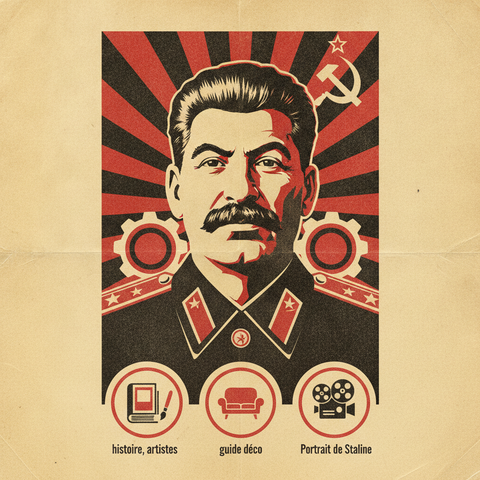
| Propaganda poster | State workshops (anonymous) | 1929 - 1953 | Flat colour fields, red flag and hammer-and-sickle backdrop, slogans in Cyrillic |
| Official Kremlin photograph | TASS studios | 1935 - 1953 | Red-star cap, military greatcoat, chest laden with decorations, systematic retouching |
| Picasso line drawing | Pablo Picasso, charcoal on paper | 12 March 1953 | Free line, close crop on the face, deliberate distance from the official canon |
Gerasimov's oil on canvas remains the benchmark for solemn portraiture: frontal framing, white uniform, carefully groomed moustache, a neutral grey or midnight-blue background. It is this aesthetic that subsequently supplied the large-format reproductions sold to embassies and state museums.
The retouched official photographs produced by TASS studios form the most abundant source: Stalin appears in greatcoat and red-star cap, his chest covered with the Orders of Lenin, of Victory and of Hero of Socialist Labour. The Stalin portrait in full military dress became the template for the majority of the decorative posters sold today through vintage channels.
The propaganda poster uses a different graphic language: vivid flat colours, a cut-out silhouette, a red flag and USSR symbols (hammer and sickle, red star) in the background. Certain pieces from the 1936-1953 period now fetch several thousand euros at specialist sales in Paris and London.
The 1953 Picasso affair: the scandal of Aragon's commissioned drawing
In March 1953, a drawing by Picasso commissioned by Aragon triggered one of the greatest cultural scandals in the PCF.
Stalin died on 5 March 1953. Louis Aragon, editor of Les Lettres françaises and a leading figure of the French Communist Party, wanted to devote a full page to the departed leader. He commissioned a portrait from Pablo Picasso, who executed a charcoal drawing in a matter of hours. The drawing appeared on the front page of the edition dated 12 March 1953. The internal reaction within the PCF was immediate and devastating.
Picasso's response: "my bouquet was not appreciated"
According to Laurent Levy in his work "Un portrait de Staline: Aragon, Picasso et le parti communiste" (Editions La Fabrique, January 2026), Les Lettres françaises received more than 200 letters of protest within 15 days of the drawing's publication, roughly a third of which called for Picasso's expulsion from the French Communist Party. The PCF leadership, represented by Maurice Thorez and Auguste Lecoeur, published a statement of regret and publicly blamed Aragon in the journal's subsequent columns. Picasso, when questioned by the press, summarised the episode in a phrase that has since become famous: "my bouquet was not appreciated".
The four key players in the scandal were:
- Louis Aragon, who commissioned the drawing and edited Les Lettres françaises, publicly blamed by the PCF leadership.
- Pablo Picasso, a PCF member since 1944, humiliated by the public rebuke but not expelled.
- Maurice Thorez, General Secretary of the PCF, then convalescing in the USSR, who left Auguste Lecoeur to manage the crisis.
- Auguste Lecoeur, Deputy Secretary responsible for organisation, who drafted the statement of regret.
The Stalin portrait affair laid bare the tensions between committed intellectuals and the party apparatus at a pivotal moment: the succession struggle at the head of the PCF between the apparatus and its cultural fellow-travellers. The episode left a lasting mark on relations between the PCF and the artistic world, and remains to this day a textbook case study in the personality cult and its limits.
Where to find a Stalin portrait in 2026: options and budgets
The Stalin portrait market is structured around four clearly defined buying segments.
The Stalin portrait market divides into four segments with distinct buying logics: period posters and reproductions, decorative prints and metal plaques, high-end Art Deco-style canvases, and decorative textiles (t-shirts, cushion covers). Each corresponds to a specific use: historical collecting, vintage décor, USSR-themed gift, or unabashed retro style.
| Product type | Price range | Typical use | Shop suggestion |
|---|---|---|---|
| Original poster 1930-1953 | 400 to 3,500 euros | Historical collection, museum-framed display | Specialist galleries and auction houses |
| High-quality poster reproduction | 25 to 90 euros | Wall décor for living room, study or themed bar | Communist posters |
| Large-format contemporary print | 15 to 40 euros | Student room, pop-culture décor | Communist posters |
| Retro metal plaque (30x40) | 12 to 25 euros | Mancave, garage or vintage bar décor | Communist metal plaques |
| Stalin portrait t-shirt | 20 to 30 euros | Retro style, USSR pop culture look | Stalin t-shirts |
| Stalin cushion cover | 15 to 25 euros | Sofa or bedroom décor, Ostalgie style | Stalin cushion covers |
On a modest budget (under 100 euros), combining a metal plaque, cushion cover and t-shirt allows you to put together a cohesive décor set in just a few clicks. The metal plaque offers the best visual-to-price ratio: 30 x 40 cm format, aged patina finish, weight and look close to an authentic Soviet workshop sign.
For a more formal setting (vintage study, committed USSR-themed bar), a framed poster remains the reference choice: 50 x 70 cm or 70 x 100 cm format, matt or satin paper, black or gilded wood frame. The best-calibrated reproductions faithfully replicate the visual codes of the 1938-1953 period (Gerasimov's white uniform, red-star cap, chest laden with decorations).
For a genuine collector's piece, the specialist auction circuit is the place to look: 1930-1953 originals change hands in the saleroom with certificates of authenticity and expert reports, often well above 1,000 euros.
Décor and style: integrating a Stalin portrait at home
A Stalin portrait works best within a décor that respects the USSR palette: red, gold, khaki and aged wood.
A Stalin portrait integrates naturally into a décor that honours its historical codes: a palette of Soviet red, imperial gold, military khaki, aged wood and matt black. Light Scandinavian interiors, clinical whites and minimalist modern furniture should be avoided - they neutralise the visual charge of the portrait. The most suitable settings are a USSR-themed bar, a mancave, a retro study or a history-enthusiast's bedroom.
Checklist for a coherent USSR-themed space with a Stalin portrait as the centrepiece:
- A red flag on the wall or draped: see the Communist flags collection for USSR, CPSU or hammer-and-sickle designs.
- Bed or sofa textiles in red-and-yellow codes: see the Communist bedding and Stalin cushion covers.
- One or two everyday accessories to anchor the atmosphere: see the Communist mugs.
- A wearable or display textile: communist cap, t-shirt or a signature piece from the retro USSR PCC kit collection.
- Indirect lighting: amber bulbs or a directed spot on the portrait - never cold white light.
Check before you hang
Three points to confirm before putting a Stalin portrait up in a visible space:
- Check the legal context: in France, Article R625-7 of the Penal Code penalises the glorification of crimes against humanity (fifth-class offence). Historical, artistic or educational representation remains entirely lawful. A portrait hung at home raises no legal issue.
- Check the private/public context: in a private domestic space, there are no restrictions. In a commercial space open to the public (bar, restaurant, shop), ensure the display remains aesthetic and historical in character rather than apologetic.
- Check the visual coherence: a Stalin portrait hung alone in a neutral room makes a stronger and more jarring statement than one integrated into a committed USSR décor. Always embed it within a coherent setting.
To explore Soviet and Russian visual culture further, take a look at these related CU collections: hammer and sickle t-shirts, CCCP t-shirts and KGB t-shirts.
Stalin portrait FAQ
Four key questions on the Stalin portrait: history, official style, artists and the legal framework in France.
What was the Stalin portrait affair?
The Stalin portrait affair refers to the controversy that followed the publication of a drawing by Pablo Picasso on the front page of Les Lettres françaises on 12 March 1953, one week after the Soviet leader's death. The drawing, commissioned by Louis Aragon, was judged disrespectful by the French Communist Party leadership. The journal received more than 200 letters of protest within 15 days, roughly a third of which called for Picasso's expulsion from the PCF. The affair left a lasting mark on relations between the party and the intellectual world.
What was the official artistic style of Stalin portraits?
The official artistic style of Stalin portraits is Socialist Realism, the aesthetic doctrine adopted by the USSR in 1934 under Zhdanov. This style favours figurative, ideologically legible representation orientated towards glorifying the leader and the Soviet people. Frontal framing, military uniform or white civilian tunic, neat moustache, chest covered in decorations, solemn neutral background: the conventions were fixed by the late 1930s and replicated almost identically through to 1953.
Which artists painted official Stalin portraits?
Three Soviet painters dominate the official production of Stalin portraits. Alexander Gerasimov signed the benchmark Socialist Realist oils, most notably the celebrated "Stalin at the 18th Congress of the CPSU" of 1939. Isaak Brodsky, trained in the academic tradition of Repin, produced monumental portraits between 1930 and 1939. Dmitry Nalbandyan developed after 1945 a more decorative, quasi-religious style featuring oversized formats intended for public buildings and congress halls.
Is it legal to hang a Stalin portrait at home in France?
Yes, it is entirely lawful to hang a Stalin portrait at home in France, within a private domestic context. Article R625-7 of the Penal Code penalises the public glorification of crimes against humanity as a fifth-class offence, but historical, artistic, decorative or educational representation remains free. The question becomes more sensitive in a commercial space open to the public (bar, restaurant), where the display should remain aesthetic and historical rather than apologetic. If in any doubt about public use, seeking legal advice is prudent.