Discovering Vladimir Ilyich Lenin: emblematic figure of the Russian revolution
of reading - words
Vladimir Ilyich Lenin is arguably one of the most influential and controversial figures of the 20th century. His life and actions shaped the political face not only of Russia, but also of the entire world thanks to his decisive role in the October Revolution and the foundation of what would become theSoviet Union. But who really was this man? What were the key events that marked his life and why does it still arouse so much debate and passion today? Let's dive into the biography and the journey of this autocrat often described as violent and bloodthirsty by his detractors, but also seen as a visionary reformer by his supporters.
Lenin's early years
Born on April 22, 1870 in Simbirsk, a town on the banks of the Volga, Vladimir Ilyich Ulyanov, known as Lenin, grew up in a relatively wealthy and cultured family. His father was a primary school inspector, helping to imbue his childhood with respect for education and intellectual values. From a young age, Lenin showed a great alertness of mind and an ability to absorb knowledge, traits that would prove crucial in his future rise.
Lenin's political convictions began to form as a teenager, influenced in particular by the execution of his older brother, Alexander, in 1887. He had indeed been involved in a plot to assassinate Tsar Alexander III. This tragic event reinforced in Lenin a deep hatred towards the tsarist regime and pushed him to actively engage in ideological struggles to overthrow what he perceived as an oppressive and unjust system.
Education and the beginning of political engagement
Pursuing a law degree at Kazan University, Lenin was quickly expelled due to his subversive political activities. This did not dampen his thirst for learning, however, as he continued to study self-taught, immersing himself in the writings of Karl Marx and specializing in Marxist philosophy. This period of intense study and reflection marked a turning point in his life, as it convinced him of the need for radical change in Russia through the adoption of Marxist principles.
After various wanderings and exiles due to his secret political commitments, Lenin managed to lay the foundations of the social-democratic movement in Russia. In 1898, he participated in the founding of Russian Social Democratic Workers' Party (RSDLP), a party which he hoped to make an effective tool to carry out his revolutionary ideas.
Accession to the leadership of the Bolshevik movement
At the beginning of the 20th century, the RSDLP split into two major factions: the Mensheviks, in favor of progressive evolution, and the Bolsheviks led by Lenin, advocating direct and revolutionary action. The latter therefore established himself as a charismatic and ruthless leader, using all necessary means to establish his authority and lead the fight against the regime in place.
Far from being just a political war, the struggle between these factions transformed into a real ideological confrontation. Under the leadership of Lenin, the Bolsheviks succeeded in channeling popular discontent aroused by the glaring inequalities and the repeated military defeats suffered by the country. The First World War further exacerbated these tensions, making Lenin's theses ever more attractive to an exhausted population.
The October Revolution: a bold takeover of power
It was therefore in this context that the defining event of Lenin's political career occurred: the October Revolution of 1917. Deeply organized and planned, this insurrection allowed the Bolsheviks to seize power in Petrograd (today Saint Petersburg) and overthrow the provisional government established after the abdication of Tsar Nicholas II a few months earlier. Lenin, now head of state, began a series of profound reforms aimed at radically transforming Russian society. To express your admiration for this revolutionary story, you can express it with a vibrant red insulated mug decorated with the image of Lenin, adding a personal touch to your support of this historic movement.
Despite the apparent successes, his takeover was certainly not without controversy. Oppositions multiplied, both internal and external. Lenin, faithful to his autocratic style, did not hesitate to use violence to subdue his adversaries. Some critics describe him as a bloodthirsty leader, ready to sacrifice many individuals in the name of the communist ideal.
The Soviet Union and Lenin's Legacy
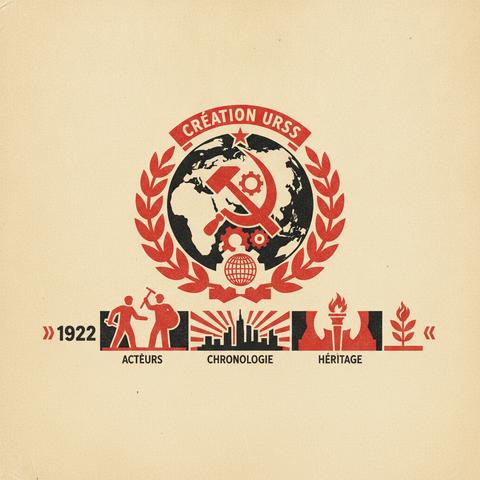
With the official establishment of theSoviet Union In 1922, Lenin made history as the founder of a new empire on the international scene. Despite his declining health, he worked to consolidate the gains of the revolution by striving to model the state structure according to Marxist precepts while attempting to maintain a certain cohesion in the face of the colossal economic challenges that the young Soviet state had to face.
However, Lenin's untimely death in January 1924 ushered in a new political era. His successor, Joseph Stalin, further accentuated the policies of centralization and purges initiated by Lenin, although some saw Lenin as a rather avant-garde reformer compared to Stalin's brutality. His emblematic effigy remains omnipresent on many communist sweatshirts contemporaries. Whichever perspective is adopted, it is undeniable that Lenin's legacy continues to profoundly influence our understanding of revolutionary movements and contemporary geopolitical dynamics.
Reflections on his philosophy and methods
The analysis of Lenin's complex personality leads us to reflect on the paradoxes which marked his political approach. Lawyer of the Marxist philosophy and champion of the proletarian cause, he nonetheless remained a man ready to resort to all forms of coercion, if necessary, to establish the model he considered just for Russia. This strong sense of realpolitik stood in stark contrast to the utopian dreams of peaceful, progressive change proposed by other socialist factions.
On the other hand, the reformative dimension of his work is manifested by certain measures taken during his reign, such as the promotion of mass literacy or the relative emancipation of women in the emerging Soviet society. These initiatives placed the communist project within a strategic framework where social conquests were considered essential to the establishment of an egalitarian society.
The contradictory assessment of the "founder of the Soviet Union"
Objectively assessing Lenin's legacy remains a delicate challenge as he embodies within himself the hopes and conflicts of an entire era. For some, its impact is most visible in the spectacular advances made in science, art and education throughout the twentieth century in the USSR and the Eastern Bloc. For others, his image remains irremediably associated with the Red Terror, systematic purges and the stifling of fundamental freedoms.
Whatever future generations may say about him, Vladimir Ilyich Lenin leaves behind a monumental legacy which continues to fuel reflection and debate within numerous academic disciplines. Observing the evolution of the current political landscape, where tensions inherited from this tumultuous history sometimes resurface, illustrates how the mark of the Bolshevik leader persists, infusing his shadow throughout contemporary history.