The five-year plan: a lever for economic strategy
of reading - words
In the world of the planned economy, the concept of five-year plan occupies a central place. Known for its historic implementation in the Soviet Union, it is essential to understand what it represents and how it transformed the dynamics of the economic development in the 20th century. This article explores the various aspects that make up the five-year plans, their impact on theindustrialization and their fundamental objectives.
What is a five-year plan?
A five-year plan designates a framework of economic planning covering a period of five years. Historically used by centralized governments, notably in the former USSR, this type of plan aims to coordinate and direct the efforts of industrial production and agricultural to stimulate economic growth and modernize the industrial sector.
The origin of the term "quinquennial" comes from the Latin "quinque", meaning five, and "annus", meaning year. This time format allows for a relatively long view but defined enough to adjust or redirect strategic efforts along the way if necessary. In practice, it is a series of directives and concrete goals assigned to different sectors of the economy, often involving the mobilization of vast human and material resources.
The objectives of the five-year plans
The main objectives common to most five-year plans includerapid industrialization, the acceleration of production in key sectors, as well as improving infrastructure. This approach often aims to massively reorient productive capacities towards industries considered strategic such as steel, chemicals, and heavy equipment.
To establish these production targets, a thorough analysis of the current and future economic needs of the nation is necessary. This includes assessing current capabilities and potential for expansion. There long term strategy is then defined to meet national ambitions for self-sufficiency or global industrial leadership.
Centralized economic planning
Economic planning in the form of five-year plans is distinguished by its centralization. In the context of the USSR, these plans played a crucial role in transforming an agrarian country into an industrial superpower. The government planned and fully controlled production chains, mobilizing all necessary resources to achieve predefined goals.
However, extreme centralization is not without challenges. Plans, although constructed with certain imprecision in a dynamic and complex environment, are often difficult to adapt to rapid changes in global economic conditions. This rigidity can compromise economic resilience in the face of unforeseen crises or accelerated technological obsolescence.
The impact of five-year plans on industrialization
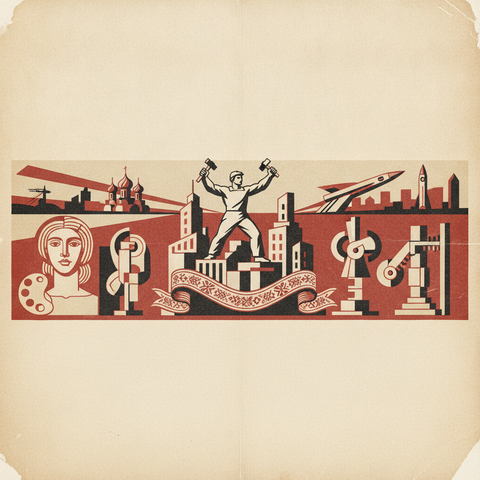
The first five-year plans, especially those of the USSR, focused intensively on industrialization. Before their introduction, Russia was predominantly rural and its economy was based primarily on agriculture. Through these ambitious policies, the creation of factories and the rise of industrial equipment have drastically changed the economic panorama. Considered as a driving force industrial modernization, the five-year plan model made it possible to quadruple steel production, triple that of coal, and rapidly develop the chemical industry. The objective was not only to make up for lost ground vis-à-vis Western industrial powers, but also to establish the USSR as a world leader in certain economic segments.
Notable historical examples
Beyond the USSR, other countries adopted this planning method to promote economic development. China, for example, under Mao Zedong, introduced its own variations of five-year plans inspired by the Soviet model. These plans also sought to strengthen the industrial base while seeking innovative solutions to avoid certain pitfalls identified in the USSR.
Each country that implemented these plans had to adapt the models according to its own contexts, sometimes allowing spectacular successes in the construction of new modern infrastructure and the transformation of entire sectors in just a few decades.
The advantages and limitations of five-year plans
The advantages of five-year plans are numerous: they provide clear direction, allow resources to be efficiently channeled towards priority objectives, and facilitate coordination between various sectors of activity. This harmonization contributes to increased efficiency in the use of resources and optimal synchronization of economic actions.
However, the limitations are also notable. Reduced flexibility in the face of economic uncertainties constitutes a major obstacle. Furthermore, the excessive centralization can lead to inefficiencies due to excessive bureaucracy, and errors in forecasts can have significant macroeconomic repercussions, particularly in terms of wasted resources or production unsuited to market needs.
The current legacy of the five-year plans
If today few countries formally use five-year plans, the idea of strategic planning remains important. Several nations integrate these concepts into their multi-year budgets or their strategies of medium term development, reflecting the sustainability of guiding principles such as the definition of clear objectives and the methodical allocation of resources.
Modern organizations like the European Union regularly draw up similar action plans for the management and coordination of major transnational projects, indirectly drawing inspiration from the five-year model. Consequently, if the very term five-year plan tends to be associated with an ideologically marked past, its fundamental principles continue to influence contemporary practices of macroeconomic governance.
Five-year plans and modern business strategies
Even in business, we find certain inspirations from the experiences of five-year plans. Many large companies establish strategic plans generally taking place over several years, where the task of setting precise directions and specific performance indicators joins the spirit of systematic planning. You might also be interested in the Communist Universe store to explore accessories inspired by this fascinating historical context.
- 🏭 Cost reductions production through optimization.
- 📈 Ambitious growth targets, often defined over five years.
- 🔗 International coordination, following a logic of large-scale planning.
In a highly competitive business context, these approaches promote better anticipation of market trends and a greater capacity to adapt to disruptive technological innovations that must be integrated into any long-term strategy worthy of the name.
Lessons from history
It is fascinating to observe how the history of five-year plans continues to offer avenues for thinking about contemporary planning, both for States and for businesses. Determining broad guidelines and consistently using data to guide decisions has become essential in a world where uncertainty and rapid change are the norm.
Thus, through a more nuanced understanding of the historic five-year plans and their legacy, it is possible to refine our current methods of strategy and management. As the global economy constantly evolves, lessons learned from these past experiences remain relevant for navigating an uncertain future with an informed perspective.