The October Revolution of 1917: a historic turning point in Russia
of reading - words
There October Revolution of 1917 marked one of the most pivotal moments in 20th century history. At the heart of this revolt, the Bolsheviks, led by Lenin, overthrew the Provisional Government of Russia and promised a new future for the Russian people. This event not only transformed Russia; it also laid the foundations for radical change on the international scene.
The root causes of the October Revolution
The background of the October Revolution of 1917 is based on a series of social, economic and political discontents. The First World War had plunged Russia into a deep crisis, exacerbated by food shortages and a chaotic railway system. The devastating human cost of the conflict for Russia had considerably weakened trust in Tsar Nicholas II and then in the provisional government who succeeded him.
In March 1917 (Gregorian calendar), the February revolution had already overthrown the tsarist regime, giving way to a provisional government. However, the latter had failed to resolve the pressing problems that tormented the population. Workers, soldiers and peasants strongly felt the need for a profound social transformation, preparing the fertile ground for a more radical insurrection.
The role of the Bolsheviks
THE Bolsheviks, led by Lenin and Trotsky, capitalized on this discontent. Their program promised "Peace, Bread and Land", thus attracting a large part of the population desperate by poverty and prolonged war. They represented a credible alternative to a government incapable of meeting the basic needs of citizens. For those interested in the aesthetics associated with the communist movement, the Shop Communist Universe offers various clothing and accessories inspired by these historical ideologies.
Upon their return from exile, Lenin and other Bolshevik leaders began to carefully prepare for the takeover. They used the Soviets, local structures of workers' councils, to disseminate their ideas and mobilize the people around their cause. This strategy made it possible to strengthen their political influence Petrograd, capital of Russia at the time.
The October Uprising in Petrograd
During the night of October 25 to 26, 1917 (Julian calendar, i.e. early November according to the Gregorian calendar), the Bolsheviks launched their decisive attack. Thanks to planning woven in concert with the Red Guards brandishing their communist flags and loyal soldiers, they took control of strategic points in the city of Petrograd.
This offensive focused in particular on the Winter Palace, seat of the provisional government. Despite limited resistance from loyal troops, Bolshevik forces invaded and arrested the leaders of the Provisional Government, symbolizing their effective takeover. Surprisingly, this event caused little bloodshed.
Immediate consequences
After the successful insurrection, the Bolsheviks rushed to consolidate their power. The next day, at the Second All-Russian Congress of Soviets, they proclaimed the transfer of power to themselves. Thus officially implying the establishment of a new socialist order. Immediately, they announced popular measures such as the Peace Decree to withdraw Russia from World War I and the Land Decree to redistribute land to peasants. Those wishing to further explore the impact of the revolution can also discover an extensive collection of memorabilia such as figurines available at Communist Universe.
This revolution not only disrupted the Russia but also had a global impact. It inspired numerous revolutionary movements elsewhere and sealed the growing ideological divide between east and west that would mark the 20th century. In response, several nations adopted an attitude of distrust towards this new form of government perceived as threatening the established order.
The post-revolutionary socio-political landscape
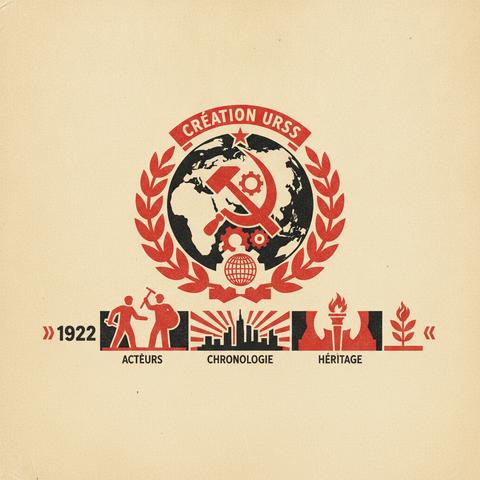
In the years following this great insurrection, Russia changed rapidly. L'USSR was formally established in 1922, consolidating the achievements of the October Revolution under the strict leadership of the Communist Party. However, these changes were accompanied by troubled times involving violence, purges and famines.
Despite these challenges, the regime's promises in terms of education, rapid industrialization and technological development profoundly transformed the economic and social panorama. These transformations brought about a society fundamentally different from that existing before October 1917, oriented towards an egalitarian, although controversial, vision.
International impact
On the world stage, the revolution left a complex legacy. Marxist-Leninist ideology became a central pillar of international relations, especially during the Cold War. Several countries embraced or sought to emulate this Soviet example in varying versions of socialism. Paradoxically, it also exacerbated geopolitical tensions, fueling a growing rivalry with Western powers.
Thus, this tumultuous period introduced new political paradigms and began a series of repercussions on global dynamics that would last long after the official end of the Cold War. Even today, we observe certain impacts and cultural references linked to this transcendent event going well beyond Russian borders.
Iconic figures and their contributions
Among the key figures associated with this revolution, Vladimir Ilyich Lenin appears as the central figure. Through his writings and speeches, he offered a sharp critique against imperialist systems, inspiring many of his contemporaries. Its strategic direction made it possible to establish an essential organizational mechanism that fertilized the rise to power of the Bolsheviks.
On the other hand, Léon Trotsky, as the principal organizer of the Red Army, contributed significantly to the initial successes of the Bolshevik forces. His tactical ability and determination contributed greatly to preventing any attempt at reconquest by anti-Bolshevik forces. The enduring philosophical debates surrounding its role demonstrate the importance of this historical tangent in the evolutionary maturation of the Soviet Union.
Another look at the revolution
However, it is worth examining the complexity surrounding this revolution and its unique historical context. Some scholars emphasize its inevitability given the dilapidated socio-economic conditions facing Russia at that time. However, others criticize the means used to achieve power and the way in which it was maintained, recalling the serious human consequences that occurred during its exercise.
These differences of opinion enrich the academic debate and remain crucial to fully understanding the drivers that propelled the revolution while providing enriching comparative perspectives on other similar historical upheavals. In any case, this significant episode is an integral part of our collective memory, stimulating ever more in-depth analyses.
Lessons learned from the October Revolution
The in-depth study of the October Revolution reveals more than a simple succession of facts; it illustrates how various actors, ideologies and circumstances interact influencing all potential directions of historical development. Therefore, by carefully analyzing this complex event, we can draw conclusions about the evolution of societies and anticipate the potential challenges they could face if similar situations were to resurface.
Beyond the battles, political strategies and internal struggles discussed here thus far, it is important to collectively commit our efforts towards a nuanced understanding including various analytical and critical angles regarding the pervasive complexities present behind each crucial historical moment. There lies the perennial interest continually renewed around the legendary October Revolution of 1917.