Hammer and Sickle: Meaning of the Communist Symbol
of reading - words
The hammer and sickle is one of the most recognisable political symbols of the 20th century. It became the official emblem of the Soviet Union in 1923 and quickly spread beyond Russia to embody the labour movement, the communist ideal and the class struggle worldwide. This article covers its origin, meaning, variants, Unicode code point and current legal status.
Key takeaways
- The hammer stands for industrial workers and the sickle stands for peasants. Crossed together, they symbolise the alliance of the two classes.
- The symbol was created in 1918 during a Soviet competition. The painter Yevgeny Kamzolkin is cited as its main author.
- It became official on the coat of arms of Soviet Russia in 1922 and then on the flag of the USSR in 1923.
- Several parties outside the USSR adopted it: the French Communist Party, the Italian Communist Party, and movements in China, Vietnam and India.
- The character ☭ exists in the Unicode table under code point U+262D.
- The symbol is banned or regulated in several Central and Eastern European countries, which equate it with totalitarian symbols.
Meaning of the hammer and sickle
The hammer and sickle form a simple icon: two crossed tools, generally set on a red background. Each tool carries a clear meaning and a precise social function.
The hammer stands for the industrial proletariat. It is the tool of the factory worker, the metalworker and the blacksmith. It evokes production, machinery and the manual labour of the cities.
The sickle stands for the rural proletariat. It is the tool of the peasant, the reaper and the field worker. It evokes agriculture, the harvest and the rural world.
Crossing the two tools expresses the central political goal of the Bolshevik movement: to unite industrial workers and peasants within a single social class, the proletariat, in order to overthrow bourgeois power and build a classless society. The red background, chosen as the dominant colour, recalls the blood shed by revolutionaries since the Paris Commune of 1871.
Origin of the symbol: Soviet Russia, 1917 to 1923
The hammer and sickle emerged directly out of the Russian Revolution of 1917. The new Bolshevik government wanted an emblem that would speak to a mostly peasant population while also including the urban working-class minority.
The 1918 competition
In April 1918, the Soviet authorities launched a public competition to design the seal of the young Russian Soviet Federative Socialist Republic. Several combinations of tools were proposed: sword and plough, hammer and anvil, ear of wheat and hammer. The painter Yevgeny Kamzolkin is generally credited as the main author of the selected version, which he drew in his studio in Pushkino.
Official adoption
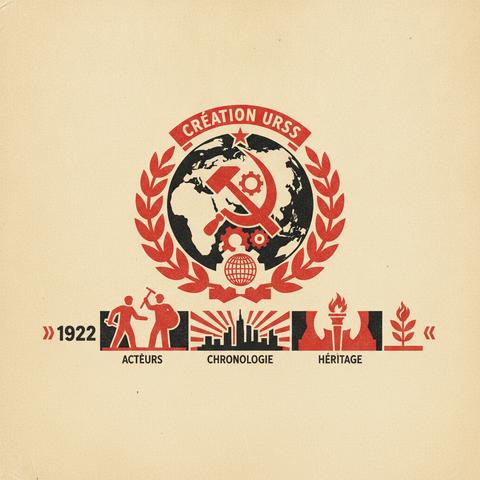
The final version was approved in July 1918 and appeared on the seal of Soviet Russia. In 1922, it became the emblem of the newly formed Soviet Union. In 1923, the hammer and sickle appeared on the flag of the USSR, together with a five-pointed red star.
If you want to identify the historical flags of that era, our communist flag collection brings together the main versions of the red flag bearing the hammer and sickle.
The official emblem of the USSR
The hammer and sickle did not remain a simple propaganda logo. It became a state insignia displayed on all official supports of the Soviet Union.
| Support | Year | Use |
|---|---|---|
| Seal of Soviet Russia | 1918 | First official version, framed by ears of wheat |
| Emblem of the USSR | 1922 | Federation of republics, added globe of the Earth |
| Flag of the USSR | 1923 | Yellow hammer and sickle on red background, red star at the top |
| Soviet coinage | From 1924 | Silver rouble and later coins |
| Official architecture | 20th century | Moscow metro stations, railway stations, public buildings |
The symbol also appeared on uniforms, on military decorations such as the Order of Lenin, and in the official press, including Pravda and Izvestia.
Adoption beyond the USSR
The hammer and sickle quickly travelled beyond Soviet territory. After 1919, the Communist International (Comintern) took up the symbol and spread it to its affiliated parties around the world.
In Europe, the French Communist Party (PCF) integrated it into its logo from its foundation at the Congress of Tours in 1920. The Italian Communist Party used it until its dissolution in 1991. The Portuguese Communist Party, the Communist Party of Greece and several parties in Central Europe made the same choice.
In Asia, the People's Republic of China took up the hammer and sickle in 1949 on the flag of its ruling party. Vietnam, Laos and North Korea also adopted the symbol on the flags of their parties. In India, the Communist Party of India (Marxist) still uses it as its main emblem. In Cuba, the party has used it since 1965.
This worldwide diffusion made the hammer and sickle the most easily identifiable symbol of international communism, even more so than the red star on its own. You can find this imagery on our communist clothing and our communist accessories.
Graphic variants of the symbol
The hammer and sickle has appeared in several variants depending on the country and the period.
- Pure version: hammer and sickle crossed on a red background, with nothing else.
- Official Soviet version: yellow hammer and sickle topped by a five-pointed red star.
- Version with ears of wheat: the two tools are surrounded by a wreath of wheat, as on the coat of arms of the USSR.
- Version with a cogwheel: a reinforced symbol of industrial labour.
- National variants: the PCF sometimes adds a raised fist, while the Communist Party of China places the tools on a yellow disc.
You can also find the symbol on more discreet items, for example our grey and blue hammer and sickle ring.
The Unicode code point ☭
The hammer and sickle has officially existed in the Unicode table since version 1.1, published in 1993.
- Character: ☭
- Unicode code point: U+262D
- Official name: HAMMER AND SICKLE
- Block: Miscellaneous Symbols
In practice, any modern computer, browser or application can display the symbol without installing a special font. On smartphones, some keyboards offer it as an emoji or a shortcut. This anchoring in Unicode is one of the reasons why the hammer and sickle remains visible online, in usernames, social media bios and political forums.
Current bans and regulations
Several countries have legislated on the public use of the hammer and sickle, generally placing it on the same level as fascist or Nazi symbols.
| Country | Status |
|---|---|
| Hungary | Banned in public, with educational exceptions |
| Poland | Banned in propaganda and advertising |
| Lithuania, Latvia, Estonia | Banned at public gatherings |
| Ukraine | Banned since the decommunisation law of 2015 |
| Georgia | Banned in public spaces |
| Indonesia | Banned since 1966 |
In these countries, exceptions exist for art, education and research. Elsewhere, the symbol remains legal and is used by parties, trade unions and social movements.
The hammer and sickle today
The symbol has moved well beyond its original official context. It appears in many contemporary uses: May Day flags, trade union demonstrations, anti-fascist gatherings, rock band graphics, album covers, film posters, video games, t-shirts, caps and badges. On social media, the character ☭ comes back in usernames, bios and emojis.
Wearing it today often expresses loyalty to a working-class history, a position on the radical left or a taste for Soviet aesthetics. If you want to bring this imagery into your own style, take a look at our communist flag, communist clothing and communist accessories collections. Shipping is free.
FAQ about the hammer and sickle
Who invented the hammer and sickle?
The painter Yevgeny Kamzolkin is generally credited as the main author of the version selected during the Soviet competition of 1918. The drawing was then adapted by the official services of the young Soviet Russia.
What exactly does the hammer and sickle represent?
The hammer represents industrial workers and the sickle represents peasants. Crossed together, they symbolise the alliance of the two working classes in order to build a socialist society.
Why is the background red?
Red has been the colour of the labour movement since the Paris Commune of 1871. It evokes the blood shed by revolutionaries and the solidarity of the working classes. The yellow hammer and sickle stand out strongly against this red background.
Is the hammer and sickle banned in France?
No. France has not legislated against this symbol. It is still freely used by communist parties, trade unions and left-wing movements. Several countries in Central and Eastern Europe, however, have banned it.
What is the difference between the hammer and sickle and the red star?
The five-pointed red star is another communist symbol, often associated with the hammer and sickle but distinct from it. On the flag of the USSR, the two appear together. The red star generally refers to the army, the party or the Soviet state, while the hammer and sickle refers to the working class.